You have been at your desk since 9:00 AM. It is now 3:15 PM. You are staring at a blinking cursor on a Google Doc, or mindlessly tabbing between Slack and your inbox.
You have been "working" for six hours, yet in this specific moment, your actual cognitive output is effectively zero. So, you do what any modern professional does: You grab a third cup of coffee, grit your teeth, and try to force your brain to focus.
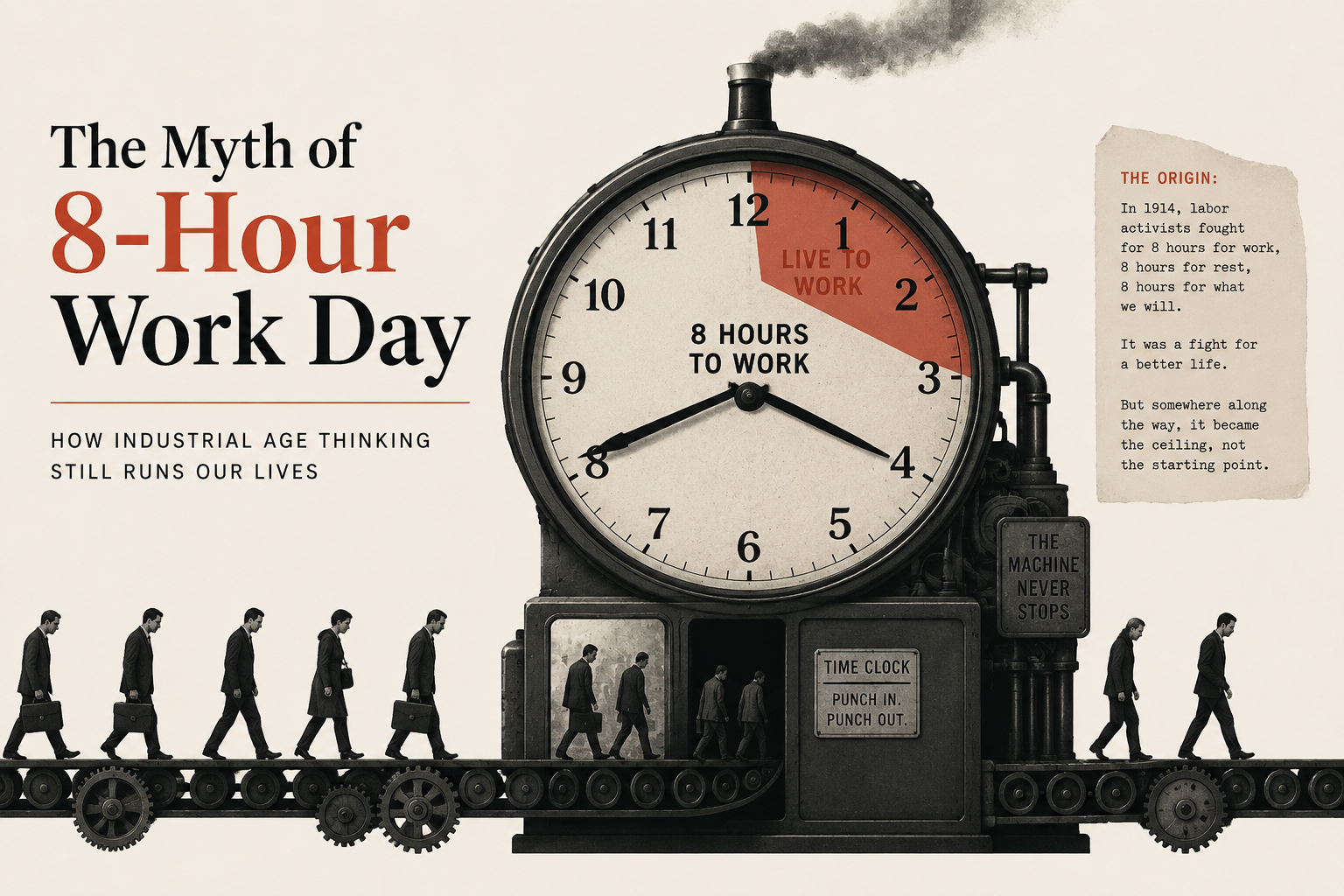
We feel guilty when we cannot sustain focus for eight consecutive hours. We assume we lack discipline. But the reality is far less personal: The eight-hour continuous workday is a historical hangover from the Industrial Revolution. It was designed for assembling cars, not for generating ideas, writing code, or solving complex problems.
Biologically, your brain is fundamentally incapable of running a cognitive marathon. It is, however, beautifully optimized for a series of highly intense sprints.
The Factory Floor vs. The Prefrontal Cortex
To understand why the eight-hour day feels so unnatural, you have to look at where it came from.
In the late 1800s, factory workers were routinely pushed to work 12 to 14 hours a day on assembly lines. The "8-hour day" was championed by labor unions and famously institutionalized by Henry Ford in 1926 as a human rights triumph: Eight hours of labor, eight hours of recreation, eight hours of rest.
For physical, repetitive labor, this model works flawlessly. An assembly line moves at a constant speed. A human turning a wrench can produce roughly the same output at hour two as they can at hour seven.
But knowledge work does not scale linearly. Your brain is not an assembly line; it is a highly metabolically expensive biological processor. The prefrontal cortex, the part of your brain responsible for deep focus, logic, and creativity, consumes a massive amount of glucose and oxygen. It cannot sustain peak output indefinitely.
Enter the Ultradian Rhythm
We are all familiar with the Circadian Rhythm: the roughly 24-hour biological clock that dictates our sleep-wake cycles. But hidden inside that 24-hour clock are smaller, faster cycles called Ultradian Rhythms.
In the 1950s, a pioneering sleep researcher named Nathaniel Kleitman discovered that the human brain moves through 90-minute sleep cycles at night. But Kleitman made a secondary discovery that changed the landscape of performance science: These 90-minute cycles do not stop when we wake up.
During the day, our brain operates on what Kleitman called the Basic Rest-Activity Cycle (BRAC).
- For about 90 to 120 minutes, your brain can sustain high-frequency electrical activity (Beta and Gamma waves), allowing for intense focus, pattern recognition, and flow.
- After that peak, the brain naturally transitions into a trough. It drops into lower-frequency waves (Alpha and Theta) for about 20 minutes, initiating a biological need for rest and recovery.
What Happens When You Ignore the Trough
When you hit that 90-minute mark, your biology sends you clear signals: You start to fidget. You lose your train of thought. You suddenly feel a strong urge to check your phone, open a new browser tab, or grab a snack.
This is your brain's "check engine" light coming on. It is telling you that its neurochemical reserves are depleted and it needs 20 minutes of rest to clear out metabolic waste and replenish glucose.
When you override your body's natural need for rest, you trigger a stress response. The brain, assuming there is a survival-level emergency keeping you awake, signals the release of adrenaline and cortisol to keep you going. This creates the illusion of a "second wind." But you are not generating new, healthy energy, you are burning your emergency reserves.
Pushing through the Ultradian trough leads to shallow, error-prone work in the afternoon, and leaves you feeling completely wired and burnt out by the time you go to sleep.
The Antidote: 90-Minute Biological Sprints
The world's highest performers, from elite athletes to master musicians to prolific writers; do not work continuously. They work in deep, uninterrupted pulses, followed by deliberate recovery.
In a landmark 1993 study on expert performance, psychologist Anders Ericsson found that elite violinists did not practice for eight hours a day. Instead, they practiced in highly focused, intense sessions lasting no longer than 90 minutes, taking breaks in between.
To map your workday to your biology, you must shift your mindset from a marathon to a sprint-and-recover model:
- The 90-Minute Sprint: Pick one highly demanding cognitive task. Turn off your phone, close your email, and work with zero distractions. Ride the natural peak of your brain's high-frequency waves.
- The 20-Minute Disconnect: When you feel your focus start to slip (usually around the 90-minute mark), stop. Do not switch to checking email, that is still cognitive load. You must physically step away. Go for a walk, stare out a window, stretch, or make a cup of tea. Let your brain drop into its natural Alpha-wave rest state.
The Takeaway
The modern workplace measures value by hours at a desk, but your biology only measures energy and focus.
Stop trying to force an industrial-era framework onto your neurobiology. You will produce higher quality work in three focused 90-minute sprints than you ever will in eight hours of continuous, agonizing, low-level grinding.
Respect the peak. Honor the trough.