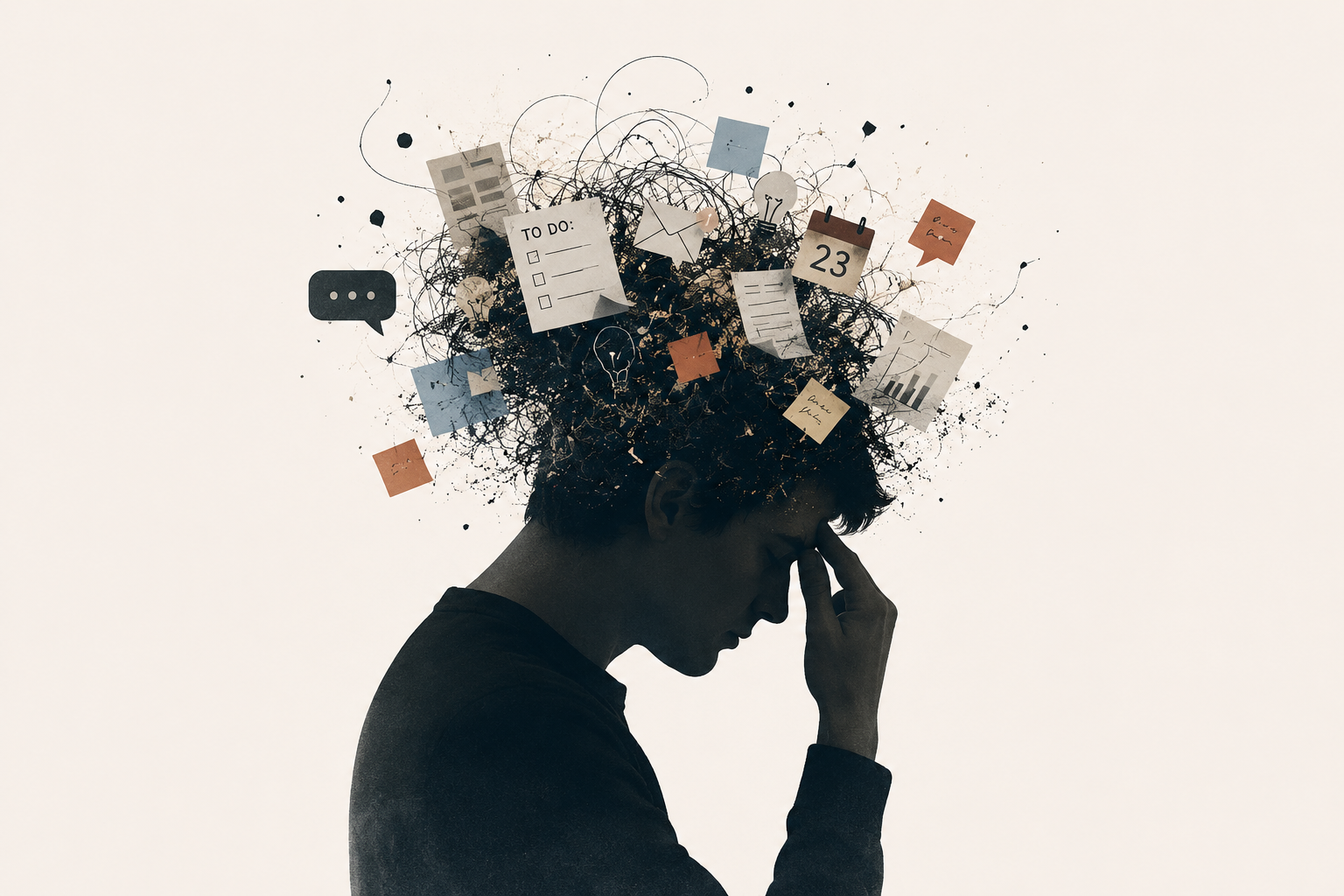
You know the exact feeling. It's 11:30 PM. The house is quiet, you're lying in bed physically exhausted, but your brain has decided it's the perfect time to run a mental marathon.
"Don't forget to email Sarah back in the morning. I really need to cancel that app subscription before they charge me another forty bucks. Wait... did I pull the chicken out of the freezer?"
It feels like you just have a lot on your plate, right? Just a normal, busy adult life. But biologically speaking, what you are experiencing in that moment is an acute neurochemical event. You are forcing your precious brain to act as a dusty storage drive rather than a high-speed processing unit.
In cognitive psychology, the simple act of dumping your unwritten tasks onto paper (or into an app) is called cognitive offloading. And if you aren't doing it, you are actively draining your working memory, spiking your stress hormones, and making it neurobiologically impossible to do deep, meaningful work.
"Your mind is for having ideas, not holding them."
— David Allen
The 4-Tab Limit and The Zeigarnik Effect
Let's start with a hard truth: Your working memory has a terrible, almost embarrassingly small capacity.
For decades, pop psychology told us we could juggle about seven pieces of information at once. But a landmark review by cognitive psychologist Dr. Nelson Cowan (The Magical Number 4 in Short-Term Memory, 2001) proved the reality is much bleaker. The average human can only hold about four chunks of information in their working memory at any given time.
Think of your working memory as a computer's RAM. We all know that feeling of having 74 browser tabs open until the computer fans start sounding like a jet engine. When you don't write down a task, it stays open in the background, chewing up your active processing power.
This glitch is governed by the Zeigarnik Effect, discovered by Russian psychologist Bluma Zeigarnik in 1927. She found that the human brain is hardwired to remember incomplete or interrupted tasks far better than completed ones. When you leave a task unfinished or just hold an "open loop" like a mental sticky note to call your mom, your brain creates task-specific tension. It continuously pings your conscious mind to prevent you from forgetting.
If you have just five unwritten tasks floating around, your "RAM" is already maxed out. You literally do not have the cognitive bandwidth left to solve complex problems, be creative, or even hold a fully present conversation.
When Thinking Becomes a Stressor: The Cortisol Spike
When your working memory is overloaded by unwritten tasks, your brain doesn't just slow down. It throws a physiological tantrum.
A 2022 review published in Nature Human Behaviour (Białek & De Neys) highlighted that sustained cognitive load and decision fatigue aren't just "tiring." They act as an actual neurobiological stressor. When the brain detects that its working memory is overwhelmed, it signals the hypothalamus-pituitary-adrenal (HPA) axis to release cortisol, our primary stress hormone.
This creates a brutal, vicious cycle. According to neurobiology research by Dr. Amy Arnsten (2009):
- Elevated cortisol rushes to the prefrontal cortex (the part of your brain responsible for focus, logic, and getting things done).
- The stress hormone physically binds to the receptors there.
- This literally impairs the prefrontal cortex's ability to operate.
In plain English: Keeping tasks in your head stresses you out. That stress produces cortisol. That cortisol damages your brain's ability to hold onto those very tasks, leading to more panic, more cortisol, and total mental exhaustion.
This is exactly why you can feel completely, utterly burnt out after a day of "just thinking" about what you have to do, even if you haven't crossed a single item off your list!
The Death of the Flow State
If you do any kind of knowledge work, your ultimate goal is entering "Flow", a concept pioneered by psychologist Mihaly Csikszentmihalyi. You know Flow. It's that magical state of complete, frictionless absorption in a task where two hours feel like ten minutes.
Flow requires vast amounts of uninterrupted cognitive bandwidth. It demands that your prefrontal cortex is relaxed, engaged, and laser-focused on a single objective.
- You cannot enter a flow state if your brain is dedicating 40% of its energy to holding onto a mental grocery list.
- Every time the Zeigarnik Effect triggers a background reminder ("Hey, don't forget the car needs an oil change!"), it acts like an annoying co-worker tapping you on the shoulder.
- Research shows it takes the brain roughly 20 minutes to fully re-enter a state of deep concentration after being interrupted.
Unwritten tasks don't just sit quietly in the back of your mind. They are active, loud saboteurs of your deepest, most valuable work.
The Antidote: Cognitive Scaffolding
Here is the good news: Psychology does not recommend trying to "focus harder." You cannot out-willpower your own neurobiology. Instead, the solution is beautifully simple: cognitive offloading.
A 2020 study published in Cognitive Psychology (Risko & Gilbert) demonstrated that externalizing choices and tasks onto a physical medium drastically improves decision quality and immediately reduces stress responses.
When you write a task down in a trusted system, whether that's a messy leather notebook, a sleek Notion dashboard, or just the Notes app on your phone, you are breaking the Zeigarnik loop. You are sending a biological signal to your brain: "The information is safe. You can let it go." The task is no longer your brain's responsibility to hold; it is only its responsibility to execute when the time comes.
The Takeaway
Stop using your brain as a filing cabinet. It is a terrible, leaky storage device, but an absolutely incredible processing unit.
The next time you feel that familiar wave of anxiety washing over you at your desk, don't just close your eyes and take a deep breath. Grab a piece of paper. Do a brain-dump. Write down every single open loop, unwritten task, and vague obligation floating around in your head.
Watch how fast your heart rate drops. Watch how quickly the fog clears. That isn't just the relief of being organized. That is your prefrontal cortex coming back online.